

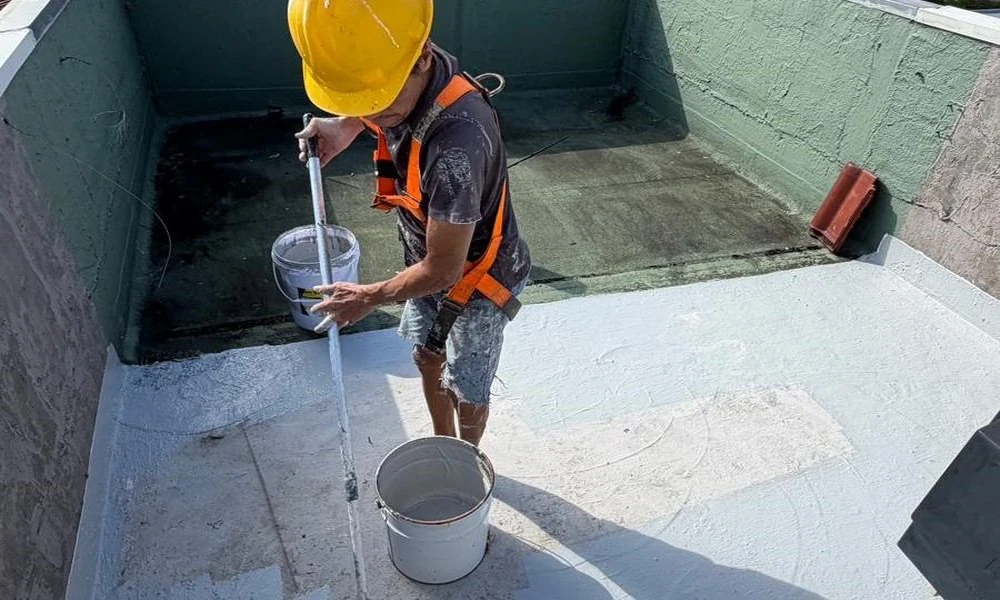
A flat concrete roof that has never leaked is easily assumed to be sound. In practice the membrane beneath the screed has a finite life, and by the time water appears on the ceiling below it has usually been failing for some while. This is the argument for preventive roof waterproofing for ageing flat concrete rooftops: renewing the protection on a planned basis, while the slab is still dry and the reinforcement undamaged, instead of repairing after the structure has already suffered.
How Flat Roofs Differ From Pitched Ones
A pitched roof sheds water by gravity, and its coverings need only resist rain in passing. A flat roof holds water, if only briefly, and relies entirely on a continuous waterproof layer. Falls towards the outlets are shallow, so any settlement or blocked drain leaves standing water. The membrane must therefore remain intact across the whole surface, at every joint and around every pipe, for the roof to stay dry.
What Ageing Does to a Concrete Roof
Singapore’s climate is hard on roofs. Daily cycles of intense sun and sudden rain cause the slab and its coverings to expand and contract, opening fine cracks in screeds and at joints. Ultraviolet exposure embrittles older membranes. Sealants around pipes and plinths dry out and pull away. Vegetation takes root in gutters and corners. None of this is dramatic on any single day, but over fifteen or twenty years the cumulative effect is considerable.
Why Leaks Appear Late
Concrete is porous enough to absorb a good deal of water before any reaches the soffit. A breach in the membrane may feed moisture into the slab for months, where it travels sideways along cracks and construction joints. The stain that eventually shows indoors may be metres from the point of entry. By then the slab is saturated, and the damage is no longer limited to the waterproofing layer.
The Cost of Letting the Slab Stay Wet
Persistent moisture reaches the steel reinforcement. As the steel corrodes it expands, cracking the surrounding concrete and eventually pushing pieces off the ceiling below, the condition known as spalling. Repairing spalled concrete is slower and costlier than renewing a membrane, and it must be done in addition to the waterproofing, not instead of it. For this reason preventive roof waterproofing for ageing flat concrete rooftops is best regarded as protection for the structure itself and not only for the finishes beneath it.
Signs That a Roof Is Due for Attention
Several indicators suggest a membrane is near the end of its life: water that remains ponded a day after rain, blistering or cracking in the exposed coating, open joints at the base of parapet walls, rust stains near outlets and plant growth along edges. Indoors, a faint damp patch that comes and goes with the weather is an early warning. A roof of twenty years or more with no record of re-waterproofing deserves an inspection regardless.
Assessing the Existing Roof
An assessment starts with a visual survey of the surface, upturns, outlets and penetrations. Moisture meters or thermal imaging can indicate where water is trapped beneath the screed. A flood test, in which outlets are plugged and the roof is ponded for a day or more, confirms whether and where it leaks. The findings determine whether the existing layers can be overcoated or must be removed down to the structural slab.
Choosing a Waterproofing System
Liquid-applied polyurethane membranes form a seamless layer and cope well with complex details. Torch-applied bituminous sheets are robust and well proven on larger open areas. Cementitious systems suit certain protected applications. The choice depends on whether the roof is trafficked, exposed to sunlight or covered by screed and tiles, and on the condition of the substrate. A contractor should explain which system is proposed, how thick it will be applied and why it suits that roof.
Details That Decide the Outcome
Most failures occur at edges and interruptions, not in the open field of the roof. The membrane must turn up the parapet to an adequate height and be properly terminated. Internal corners need fillets so the material is not folded sharply. Outlets, pipe penetrations and equipment plinths require individual treatment. Falls should be corrected where ponding occurs. A final flood test before any protective screed is laid is the only reliable proof of the work.
Maintenance After the Work Is Done
A new membrane is not a reason to forget the roof. Outlets and gutters should be cleared regularly, particularly before the wetter months at the year end. Any later installation, such as air-conditioning units or solar panels, must be fixed without puncturing the waterproofing, and the original contractor consulted if in doubt. A brief annual inspection will catch damaged sealant or blocked drains while they are still trivial to remedy.
Deciding Whether to Act Now
Owners and managing agents should consider the roof’s age, its maintenance history and what an inspection finds. If the membrane is past fifteen years, shows surface distress or holds water, planned renewal is likely to cost less than the repairs that follow a failure. Obtaining a survey and an itemised proposal commits no one to proceeding. It simply allows preventive roof waterproofing for ageing flat concrete rooftops to be weighed on evidence, at a time of the owner’s choosing.
