

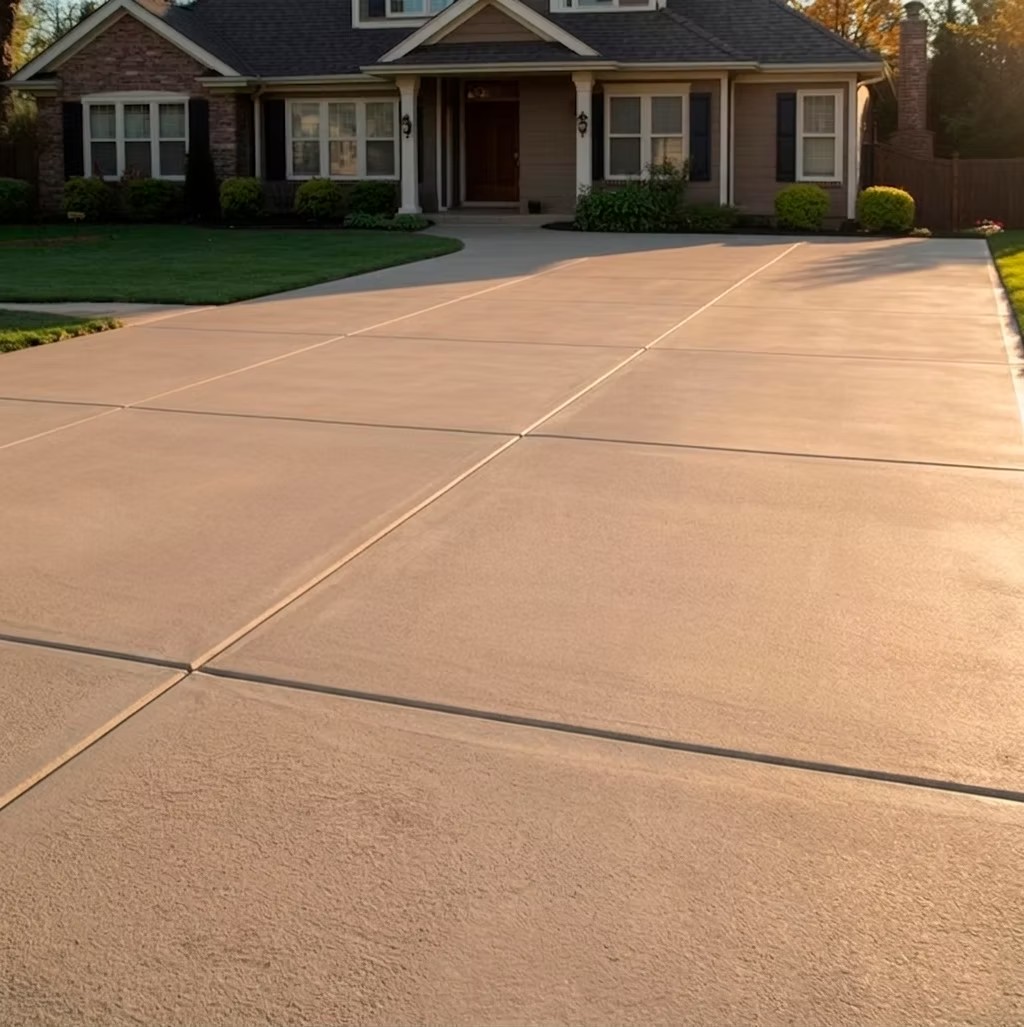
Understanding Driveway Deterioration Stages
Concrete driveway deterioration follows a progression that determines whether repair or replacement is the appropriate response. The early stage — surface crazing, minor cracking, and surface scaling — is the maintenance-appropriate stage where sealing, crack filling, and surface treatment can halt the progression and significantly extend the driveway’s useful life. The middle stage — structural cracking, significant scaling, and edge deterioration — marks the transition zone where the repair versus replacement analysis becomes relevant. The late stage — widespread structural cracking, significant settling, severe scaling across most of the surface — typically indicates that replacement is more economical than repair.
The difference between surface cracking and structural cracking matters for determining the appropriate response. Surface cracks — hairline cracks that do not extend through the full depth of the slab — can be filled and sealed effectively with appropriate materials. Structural cracks — those that extend through the full slab depth, that show vertical displacement between crack faces, or that are accompanied by settling — indicate underlying conditions that surface repair cannot address.
Settling — where portions of the driveway have sunk relative to adjacent sections — can result from soil erosion beneath the slab, improper original base preparation, or tree root activity. Surface repair cannot address settling; the underlying cause must be addressed for any surface work to have lasting effect.
Repair Options and When They Work
Concrete Driveway Repair options include crack filling and sealing for early-stage maintenance, mudjacking or foam leveling for settled slabs where the concrete itself is still structurally sound, and partial or full panel replacement for sections that have deteriorated beyond surface repair effectiveness.
Mudjacking — the injection of a cement-sand slurry beneath a settled slab to raise it back to grade — is effective when the slab itself is in good condition and the settlement is limited to specific areas. The technique requires access holes drilled through the slab, which are filled and patched after the leveling is complete. It is significantly less expensive than replacement for appropriate candidates.
Partial panel replacement — removing and replacing specific sections of the driveway while retaining sections in good condition — is the intermediate option between repair and full replacement. It is most economical when deterioration is concentrated in specific sections rather than distributed across the full driveway surface.
Portland Cement Association technical guidance on concrete repair covers the materials and methods appropriate for different types of deterioration, providing a technical framework for evaluating what a contractor is proposing and whether it is appropriate for the specific damage pattern.
The Replacement Decision
Full replacement becomes the right economic decision when the repair cost approaches a significant percentage of replacement cost, when the underlying conditions that caused deterioration have not been addressed and will continue to affect any repaired or replaced surface, or when the driveway surface condition is sufficiently widespread that targeting specific sections leaves most of the surface still in poor condition.
A replacement project is the opportunity to address underlying issues that affected the original installation — improving drainage, correcting base preparation, selecting a different concrete mix design better suited to Calgary conditions. Contractors who discuss these factors as part of a replacement proposal are providing more complete service than those who propose a straightforward replacement without addressing the conditions that drove the original failure.
The decision between repair and replacement ultimately comes down to the projected lifespan of the repaired surface versus the cost difference between repair and replacement. A repaired surface that will require replacement within three to five years anyway — because the underlying conditions are not being addressed or because the deterioration is too widespread for effective repair — may be more economical to replace immediately.
